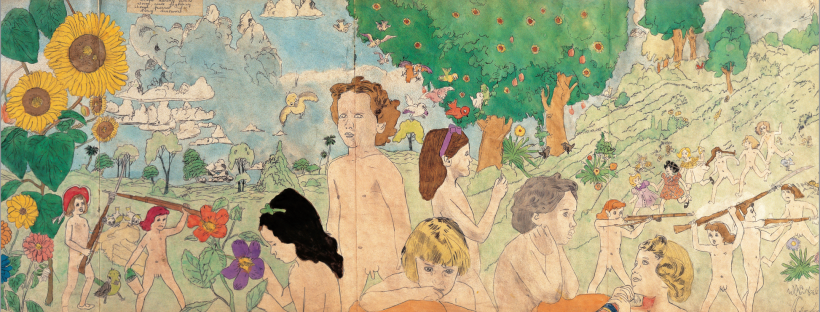
The first time I considered – like, legitimately considered – outsider art as a, well, art form, I was regrettably much older than I should have been. I was 16 and hosting a sleepover when my friend asked me if I’d heard of Henry Darger.
I hadn’t.
She went on to tell me that she’d recently read a Cracked article that had piqued her interest in his work; his work being an obsessive 15-volume,15000+ word, illustrated novel – with over 300 collaged and watercoloured illustration, some of which span up to 10ft in length – that he had written during his tenure as a janitor at a Chicago hospital.
The above mentioned book ‘The Realms of the Unreal’, or, to give it its full title ‘The Story of the Vivian Girls, in What Is Known as the Realms of the Unreal, of the Glandeco-Angelinian War Storm, Caused by the Child Slave Rebellion’ (yes, really) is Darger’s most prominent work, but it does have a 10000+ word sequel, ‘Crazy House: Further Adventures in Chicago’, which continues the story of The Realms’ protagonists, the seven Vivian sisters. The Vivian Girls are princesses assisting the titular Child Slave Rebellion after the assassination of child rebel leader Annie Aronburg, and are often depicted fighting (or being straight-up massacred) by the story’s villains. The Vivian Girls are also frequently depicted naked and with penises, in a borderline paedophillic, voyeuristic way…Although, allegedly, it’s representative of Darger’s late-Victorian era innocent boyhood, corrupted by his mother’s death, his father’s hospitalisation, and his own stay in the Illinois Asylum for Feeble-Minded Children, diagnosed with “self-abuse” – because, y’know, masturbation is a mental illness, right? The Realms’ includes a self-insert character of Darger, playing the role of a protector of children despite the rather brutal circumstances that Darger, as an author, places his characters into. Even so, from the sheer volume of work, you can see Darger’s clear passion (obsession?) for the project – and the traumas that influenced it. In fact, the incendiary event for Darger to begin work on his magnum opus was the loss of a newspaper clipping, featuring a photo of Elsie Paroubek, a 5-year-old murder victim (who was, at the time, alleged to have been kidnapped and murdered by g*psies, because I’m apparently never more than six degrees of separation from anti-Romanyism whenever I decide to research things), with Darger describing the loss of the newspaper clipping as a “…huge disaster and calamity,”…”[which] shall be avenged to the uttermost limit.” It should be mentioned that Paroubek was fictionalised in Darger’s story as the previously-mentioned Annie Aronburg.
So, what does this have to do with outsider art?
Well, Darger had no formal artistic training and yet (after his work was salvaged by his landlords Nathan and Kiyoko Lerner to supplement the rent money he owed them) his work posthumously makes upwards of $750,000. A documentary about Darger’s works, Jessica Yu’s “In The Realms Of The Unreal”, won the 2004 National Film Board Award for Best Documentary. He’s still being referenced even now, almost half a century after his death in 1973. So why is his work classified as “outsider art” and not merely…”art”? Is it because of Darger’s lack of artistic knowledge? Does that alone outweigh his dedication to his work, his frankly astronomical output of illustrations and writings? Does it outweigh the value assigned to his work by the art industry – or is that value because of his outsider status, encouraging people to view his life’s work as little more than kitsch spectacle?
The view of high art as a snobbish and exclusive club, qualifying “lesser” or untrained artists as “outsiders” or “naive” for a lack of connections to the established art scene or lack of formal art education (despite in many cases having abundant skill or artistic vision, which the art community supposedly prizes) leaves a bitter taste in my mouth. As a mentally ill, working class person, seeing Art Brut and its derivatives being confined to patients of mental institutions, children, those who can’t afford an art education (in the first world) or those who don’t have access to it (elsewhere, often giving things a barely-disguised layer of racism or exoticism) feels…patronising, at best, and downright insulting and alienating at worst.
Compare the concepts of craftsmen and artisans; their empirical knowledge of their workstyle and medium is often framed as being gained through years of firsthand experience, experimentation, or hard work – much like outsider artists. And yet, craftsmanship is exalted. In his book, ‘The New Artisans”, Olivier Dupont writes “It is time to pull the word “artisan” out from its dusty shelf and give it back its noble status. For some years now, a quiet but assertive movement has been breathing new life into the world of artisanship. Its leaders are not any old craftsmen; rather, they are an exciting new generation of practitioners who have come to the fore. The “handcraft” movement they espouse has gained momentum and now, propelled by these uniquely skilled independent designers and artists, it has reached new heights. Highly talented crafters around the world have been working laboriously and passionately, experimenting with techniques and materials, to produce high-quality, modern, desirable, one-off objects of creation.” This passion for their work is, according to Dupont, one of the key tenets of the respectable, modern artisan. And yet, the same respect isn’t afforded to naive artists, no matter how much notoriety they gain through their work. Craftsmanship in its various forms can be easily accepted into conventional artistic canon as something aesthetically beautiful (while also possessing functionality, something that often drags art down to the level of merely being an “object”).
Although, perhaps the distinction is much more obvious than that. To artists and society alike, outsider artists are outsiders first, artists second. Perhaps the aim of these artists is not to produce art that can be monetised, or art that conveys some grand, high concept, but rather to create the most pure form of artistic self expression. Maybe outsider artists make art because they enjoy it; and, really, isn’t that the purest, most authentic form of art? Perhaps one day, naive art will find its place within artistic canon, without the patronising air with which it is regarded now.
Or maybe, just like Henry Darger, those who were outsiders in life and in art, will always remain outsiders.
 sepulchre.fashion