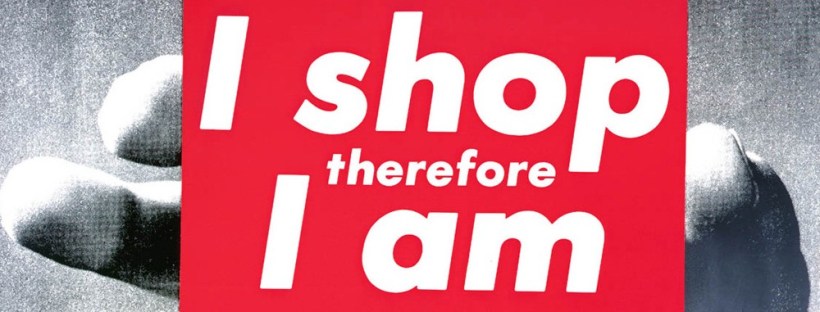
Speaking of the mid-1960s, around the same time as the launch of his homeware and furniture store, Habitat, Terence Conran (quoted by Whiteley N. in his 1993 book, Design For Society) said:
“There was a strange moment around the mid-60s when people stopped needing and need changed to want….Designers became more important in producing “want” products rather than “need” products, because you have to create desire.”
Obviously, this was a comment on the shift of society towards mass-manufactured consumerism in a post-war society – food rationing in the UK didn’t end until 1954, almost a decade after the end of WWII and 14 years after rationing was first imposed, and by the time the 1960s arrived, consumer items were shifting rapidly towards the ephemeral and replaceable (paper dresses, anyone?), becoming more indicative of today’s era of late-Capitalist society. Introducing items that catered to trendy, short-lived fads was a good idea to strengthen a post-War economy, and as identity became increasingly more diverse with the inception of youth culture, products that seemed desirable were an easy-sell to a society that increasingly sought out status symbols, a social trend that is still reflected in modern society.
However, looking at this quote in the context of modern society, when society as a whole is more socially, environmentally, and economically conscious, it seems rather disingenuous to refer to an item as a “”want” product”. Were something like this published by a contemporary creator or writer, the purpose would surely be to guilt the average consumer into sacrificing luxuries [wants, not needs] in day to day life; similar to the current debate on climate change, where around 100 corporations are responsible for the vast majority of all pollution contributing to climate change, yet centrists and the moderate left seem to think the blame lies with individuals that use non-recyclable straws…which, admittedly, being environmentally conscious in small ways is a good thing, but the point still stands; the onus for environmental and societal change doesn’t fall on any one nameless individual. When there are such vast inequalities in our global society, and even on a smaller scale within our own Western society – the surplus of wealth vs abject poverty – rather than having the average person sacrifice nonessential “luxury” items, perhaps we should improve the lives of those living in poverty and raising the standard of living in line with modern life and demands? Of course, with the water crisis in Flint, Michigan, still ongoing after almost 4 years of campaigning, it’s apparent that things like “essentials” and “fundamental human rights” take a back-seat to profit and exploitation.
Even on a less extreme front, modern society is so reliant on consumption that this cynical approach to consumerism falls completely flat. In an increasingly post-modern society, identity is shaped by consumerism – the leisure activities we do, the media we consume, the way we present ourselves through clothing, makeup, hairstyles – none of which are necessarily “essential” to survival in a strict sense, but most people arguably rely on entertainment and shopping as a form of emotional regulation; retail therapy.
 Similarly, in a society so obsessed with wealth, status, and other people’s perception of us, purchasing the newest, freshest, most desirable item to show off on social media has become so ubiquitous that it even has its own term – flexing. With social media being the most popular way of communicating for young people, always having new, cool things to show off on your instagram profile almost seems like a tangible pressure to be on the cutting edge of trends. In a society where our identity is shaped by the things we consume, then people’s perception of us is shaped by the things we display; remember two years ago when everyone with upwards of 50k followers was wearing Vetements’ DHL shirt in their selfies?
While nonessential products are, well, nonessential (in terms of pure survival, at least), begrudging the average person the right to a little luxury due to a cynical view that they don’t “need” it is hideously backwards. As much as most people (among my peer group, at least) would like to be more ethical consumers, in this late-Capitalist age that is so single-mindedly driven by profit and consumption, that’s unrealistic; especially when we as individuals have so little control over mass societal consumerism and its wider effects – again, when our individual identities rely so heavily on the things we buy.
 sepulchre.fashion